兰戈
Central China province targets $12b trade with Africa by 2028, focusing on mining and modern agriculture_我的网站

一 |

An aerial drone photo taken in October 2025 shows a view of the Dongshan pocket park in Guangzhou, south China's Guangdong Province. (Xinhua)When 72-year-old Shi Jikun opened his windows at home in Yuxi, southwest China's Yunnan Province, he used to hear the repeated thud of balls and blowing of whistles from an indoor sports venue near his residential community.
"During the day, I didn't dare open the windows," Shi said, recalling years when the noise disrupted his daily routine.
The sports venue has since undergone two rounds of soundproofing. Sound-absorbing materials were installed on its walls, while double-glazed soundproof windows were fitted along the side facing the residential area.
The noise has eased. "The neighborhood is quiet now, making everyday life much more comfortable," Shi noted.
Shi's experience is part of a broader move underway across China to tackle one of the less obvious costs of urbanization: the growing amount of noise packed into increasingly dense neighborhoods.
As cities expand, the likes of homes, roads, businesses, construction sites and recreational spaces are often crammed together. China has, notably, been testing a neighborhood-level response to this challenge via the development of "quiet communities," combining physical upgrades with local management and mediation.
This initiative was launched as a national pilot project in May 2023. By the end of 2025, a total of 3,272 quiet communities had been built nationwide, benefiting more than 2.4 million households, according to the Ministry of Ecology and Environment.
This approach now also has a stronger legal footing. On Saturday, China's Ecological and Environmental Code came into force, with a dedicated section on noise pollution prevention and control.
The scale of the problem is reflected in noise complaints. In 2025, cities at the prefecture level and above received about 6.83 million noise-related complaints, with social-life noise accounting for 73.2 percent.
Noise from neighbors, equipment malfunctions and disturbances from square dancing, a popular group exercise in China often held by middle-aged and older residents in public spaces, were among the most common issues raised.
China's quiet-community program is designed to address such problems before they become recurring disputes. "Quiet communities do not mean that there should be no sound," said Lu Lu, deputy head of the noise management division at the Ministry of Ecology and Environment.
The goal, Lu said, is to create a comfortable and harmonious living environment while balancing everyday activity with residents' need for quiet.
The solutions vary from place to place. In south China's Shenzhen, some newly built residential communities are incorporating noise control at the planning and design stage. Measures include low-noise pavements, vegetation buffers, separated pedestrian and vehicle routes, and automatic noise-monitoring equipment.
Older communities are using renovation projects to address noise concerns. In Xiaoshan District in east China's Hangzhou, Huiyu garden community replaced aging elevators and repaired drainage grates and other public facilities as part of its quiet-community program.
But physical upgrades alone cannot settle conflicts between neighbors.
At Fenglin Shunhe community in Weihai, eastern China's Shandong Province, residents, property managers, community officials and square-dancing groups agreed to end dancing at 8:30 p.m. The main lights in the square switch off at that time, signaling that it is time for the dancers to leave.
The key is to respond quickly to complaints and give residents and activity groups a way to negotiate solutions, said Jiang Chunyan, head of the neighborhood committee.
In another community in Shenzhen, property managers have gone further by treating renovation noise as a process to be managed proactively rather than a problem to be addressed after complaints arise.
Renovation work is divided into nine stages and mapped on a visual noise-management chart. Property managers use the chart to carry out targeted inspections as work progresses. Contractors are also required to work only during designated hours and under fully enclosed conditions.
The program still faces gaps in terms of regional coverage and long-term maintenance. Quiet communities remain concentrated in a few cities, while older neighborhoods and parts of central and western China have fewer projects. Some communities also face difficulties maintaining noise-control measures after initial upgrades are completed.
The Ministry of Ecology and Environment plans to incorporate quiet-community development into China's noise pollution prevention and control work for the 2026-2030 period. It has called for regular inspections, dynamic monitoring and follow-up visits to ensure that measures remain effective.
Zheng Shanshan, an official responsible for ecological affairs in Hangzhou's Xiangfu Subdistrict, said the next step should extend noise management from individual communities to larger areas through tools such as sound-environment maps.
"Quiet communities are only a starting point," Zheng said. "We hope to create more quiet spaces across the city."
。
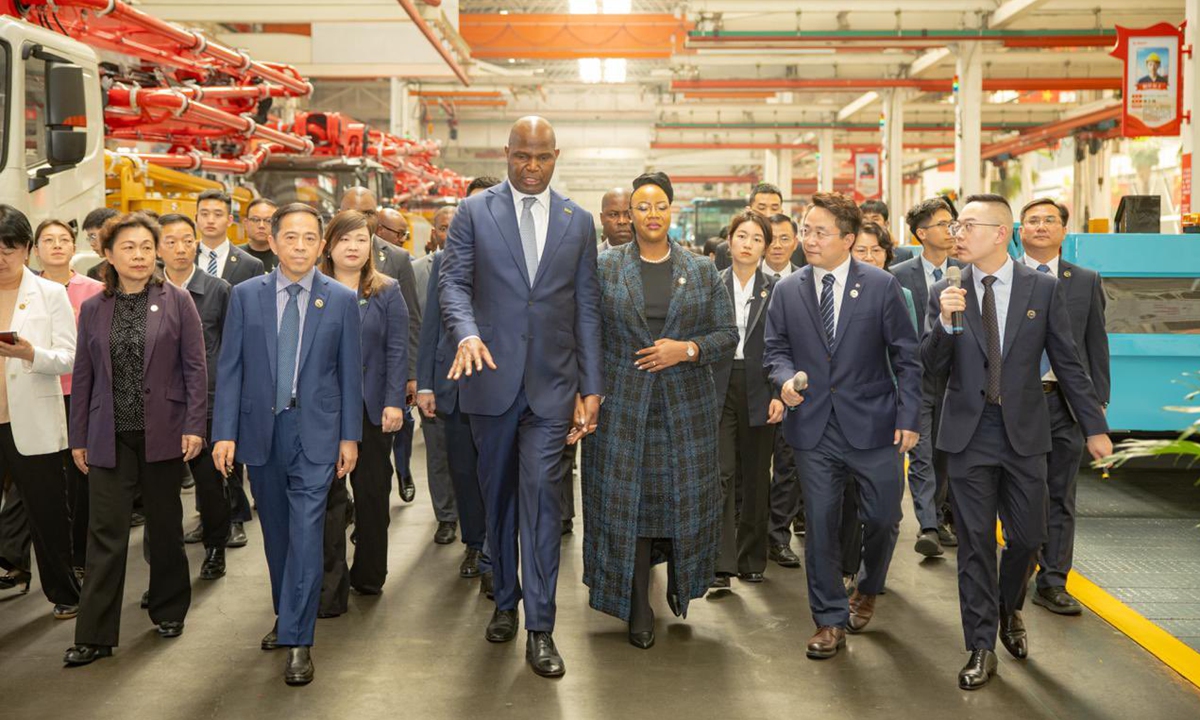
Mozambican President Daniel Chapo visits equipment manufacturer SANY Group in Changsha, Central China's Hunan Province, during his trip to China. Photo: X account of President Daniel Chapo
Central China's Hunan Province, a key locality in developing trade ties with African countries, aims to ramp up its foreign trade with Africa to 80 billion yuan ($11.86 billion) by 2028, according to a three-year action plan posted on the provincial government's website on Sunday.
The action plan focuses on 12 key African countries, aiming to build about 10 landmark projects involving production capacity cooperation and create one or two pilot projects under the "Two Countries, Twin Parks" model. The plan also aims to establish a service system for economic and trade cooperation with Africa.
The action plan highlights six of the province's competitive industries - mining, automobiles and parts, construction machinery, medical devices, modern agriculture, and green energy - and specifies differentiated and industry-specific development paths to form a full-chain and actionable road map.
The road map is one of the seven major measures outlined by Hunan to further improve trade and economic cooperation with African countries. The move is also aimed at tapping into a national policy that took effect on May 1, which expanded zero-tariff treatment to cover 53 African countries that have diplomatic relations with China.
In 2025, Hunan's trade with African countries totaled 58 billion yuan, ranking first for the seventh consecutive year among China's central and western provinces.
A Chinese analyst said on Sunday that as a locality and free trade zone that pioneers in China's trade and economic cooperation with African countries, Hunan enjoys a high level of industrial complementarity with African trading partners. Deepened cooperation between China and Africa will have particular significance amid the global headwinds of protectionism, said the analyst.
"The province's leading construction machinery sector could fit African countries' need to upgrade their raw material trade greatly and boost local industrialization. There is a perfect match of advanced Chinese production capacity with local development needs by these countries seeking to diversify their exports category," Song Wei, a professor at the School of International Relations and Diplomacy at Beijing Foreign Studies University, told the Global Times on Sunday.
Hunan has in recent years beefed up exchange and training programs for African experts, and emerging sectors such as agricultural products processing will serve as the new growth drivers of the province's cooperation with trading partners on that continent, building on the new opportunities brought by China's opening-up and a notable rise in African agricultural exports to China, Song said.
In particular, the action plan calls for improving supporting facilities for mining projects in Africa, expanding the scale of resource shipments back to China, boosting exports of mining equipment, and gradually building mining testing laboratories and setting up an investment fund for exploration in Africa in the mining sector.
The province also looks to increase exports of knocked-down vehicle kits, explore ride-hailing markets in key African countries, and expand used car exports in the automotive and parts sector and speed up product market certification to promote exports of medical equipment and supplies through China-Africa friendship hospitals in the medical device sector.
In the construction machinery sector, the action plan calls for improving alignment with Chinese-invested major infrastructure and mining engineering projects in Africa, expanding exports of branded machinery, and promoting exports of remanufactured construction machinery.
For modern agriculture, the province will set up integrated centers in Africa for agricultural machinery production, sales, and services, simultaneously cultivate projects that integrate production and trade, and coordinate the expansion of exports of competitive products and imports of distinctive African agricultural products.
In the first seven months of 2026, China's total trade with Africa reached 1.66 trillion yuan, up 18.9 percent year-on-year, closely trailing the growth rate of ASEAN at 20 percent year-on-year and making it one of China's fastest-growing trade partners.
The value of exports to Africa grew by 20.4 percent while that of imports shot up by 16.4 percent.
。
Current article:http://96uhsh.minpinpengcemiuanjiuxuan.pics/news/20260826_7684344.html
Published on:03:41:26


